
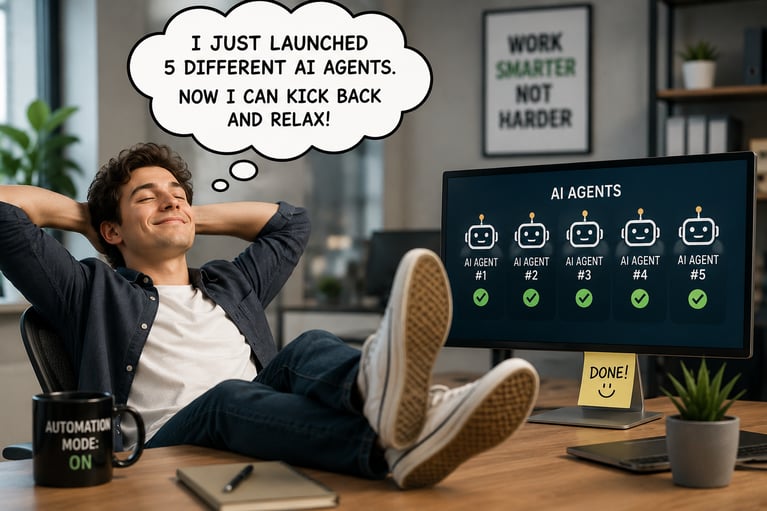
AI Stewardship in Marketing: Automation Doesn't Remove Ownership
When it comes to AI, most companies are first asking:
"Can AI do this?"
Wrong question. They should be asking:
Who's responsible when it does?
Because despite all the noise, AI's biggest business risk isn't hallucinations. It's ownership drift.
Problem being? Well, most teams don't even realize it is a problem...
...and... that's a problem.
The Assumption Nobody Questions
Let's say your team uses AI to:
✍️ Draft blog posts
📄 Build proposals
📚 Create SOPs
📧 Write emails
⚙️ Generate internal documentation
Sounds efficient. Heck, a lot of times, it is. In fact you're throwing money out the window if you don't automate a lot of that stuff.
But hidden inside that efficiency is an assumption:
Somebody else checked it.
Marketing assumes leadership reviewed it. 📢
Leadership assumes marketing validated it. 👔
Sales assumes somebody pressure-tested it. 📈
Operations assumes it came from a trusted source. 🛠️
And eventually, nobody can explain:
❓ Why that position was taken
❓ Why that language was chosen
❓ Why that recommendation exists
❓ Whether it's even still correct
The output exists. The steward...? Doesn't.
The Novice AI Handler
Despite all the hype, most organizations are still early in their AI journey. You've got a few senior members who have carved out time to play in the sandbox and are attempting to model AI usage and stewardship, but in the end, this mostly ends up in the hands of newbies.
And novice AI handlers tend to make the same mistake. They confuse automation with ownership transfer.
☑️The document got created.
☑️The process got automated.
☑️The answer appeared instantly.
So the brain quietly concludes:
"Great. That's handled."
Except it isn't. Because AI doesn't understand your business (okay, maybe that becomes less true each day, but your agents will most likely never understand your risk tolerance or truly pick up on your vision...)
At least... that's what my LLM is telling me to write...
Here's Where It Gets Weird
So anyway, guess what compounds the problem? It's (as always) that frog-in-the-pot-of-water analogy:
the drift rarely announces itself
Nobody gets an email saying:
⚠️ Your AI-generated content is now misaligned.
⚠️ Your documentation is now contradictory.
⚠️ Your positioning is starting to drift.
Instead, everything appears to work:
The blog gets published. ✍️
The proposal gets sent. 📄
The SOP gets shared. 📚
The customer gets an answer. 😄
Success!!
Until one day:
❓ A policy contradicts another policy
❓ A proposal promises something you don't offer
❓ Marketing says one thing while Operations says another
❓ An outdated process survives because nobody revisited it
Now everybody's asking:
"How did this happen?!"
Uhm.. simple: The output stayed. The stewardship disappeared.
The AI-Steward Thinks Differently
A steward doesn't assume AI's correct. A steward assumes things change:
📈 Markets change
🤝 Customers change
⚔️ Competitors change
🤖 AI models change
🏢 Your company changes... (or should)
Which means every AI-assisted asset has a shelf life.
Every workflow drifts... every automation eventually needs inspection.
Not because AI is "bad." Simply because reality moves.
The Pressure Test
Here's the question we ask any company leaning heavily into AI: (and we do, and yes, we're annoying about it)
"Could somebody on your team defend this?"
Not approve it. Defend it.
Why was it written?
Why was that position taken?
Would you still stand behind it six months from now?
Could you explain it to a client?
Could you defend it to a competitor... or to your own team?
If nobody can answer those questions, you don't have ownership. You've just got output. Useful, but you can't bet your reputation (or liability) on it.
The Knockout Punch
So here's the main jab:
Automation doesn't remove ownership.
The organizations getting the most out of AI understand that.
The ones struggling? They're often treating automation as self-maintaining.
It isn't. Oh goodness, it isn't.
Every shortcut | workflow | prompt | document... every AI-generated asset...
...still very much needs a steward.
Otherwise, you're not scaling expertise. You're scaling assumptions.
And assumptions have a funny way of showing up on the balance sheet eventually (okay, maybe a "not so funny way").
If your team is using AI to generate proposals, policies, SOPs, documentation, or operational processes (and sure, why wouldn't they?), remember:
Efficiency is only half the equation.
The other half is making sure somebody still owns the result.
Need someone in your corner when it comes to reviewing AI-generated materials for hallucinations, mismatches, redundancies, incomplete logic, and operational risk (before those issues become expensive)? Yeah, we do that.